
Double-Edge Guide
About
Double-Edge is a two-player card game first played in the book Azure Nightfall, Part 1: Gilded Dusk. As the name suggest, no action is entirely safe and is capable of endangering either player akin to a double-edged sword.
Contents:
Setup
The game is played with a standard 52 card deck. Each player begins the game with a deck of three cards called the Base. The goal is to either remove all cards from your opponent’s Base OR to add cards onto your Base until you reach a total of six. In either case, the game immediately ends. Ties are possible.
A single game is broken into rounds, each round is comprised of three turns: Player A’s Turn, Player B’s Turn, and the Action Turn. Player A and Player B alternates who goes first every round.
Jacks, Queens, and Kings are always considered to have a numerical value of 11, 12, 13 respectively.
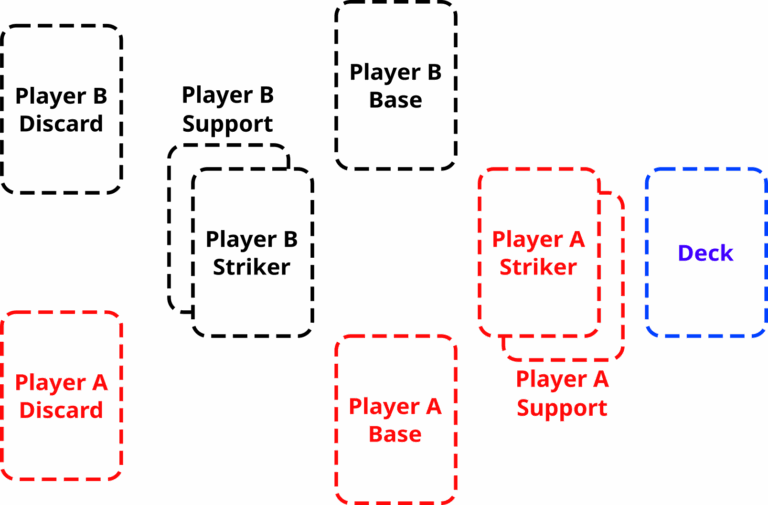
Besides their Base, both players have their own discard piles and an area to play their Strikers and Supports. The remaining cards are placed in a deck shared between both players.
- Strikers are cards played during the player’s turn that are used during the action turn to interact with the other player’s Base and Striker.
- Supports are cards played under Strikers during the player’s turn that alter how the Striker functions during the action turn.
Start:
Begin by removing the four aces from the deck and distributing two aces (one red and one black, suit does not matter) to either player. Each player is dealt of a hand of seven cards that they are to hide from their opponent. At no point can a player exceed seven cards in hand, excluding the aces that they will always have access to.
NOTE: Aces can only be played during the Action Turn. You can keep them separate, however, it is advised to conceal them with the other cards in your hand.
Base Construction:
Before the start of the first round, both players must construct their Base deck using three of the seven cards that comprise their opening hand. The cards must be chosen and organized in a specific Pattern as detailed below. A player signals that they have constructed their Base by placing it facedown on the table and drawing three new cards from the shared deck. Once both players have finalized their Bases, they flip over their entire Base, staggering it such that each card is visible. The game then progresses to the first round.
Patterns:
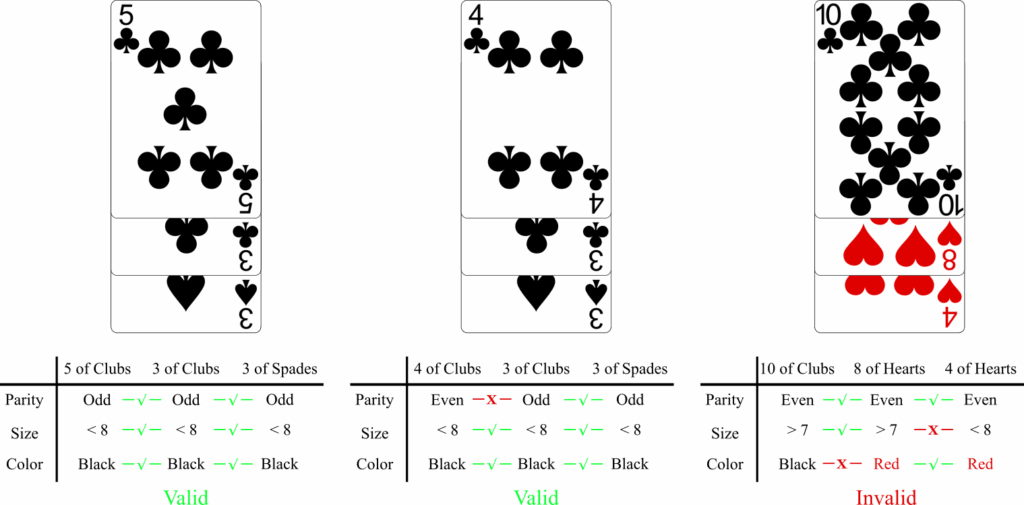
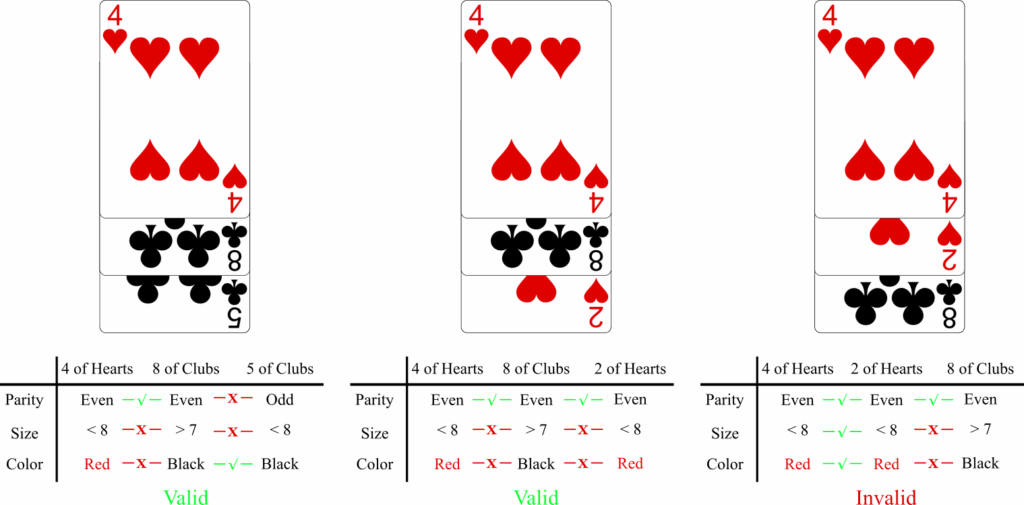
For the entire game, both players’ Base must conform to a specific pattern. There are two categories of pattern: the Straight Pattern and the Anti Pattern.
In regards to both types of pattern, every card is categorized based off three properties: color (black or red), parity (even or odd), and size (less than eight or greater than seven).
NOTE: A Base must always have a pattern, however, the specific pattern can change throughout the game. For example, if a player starts with the Straight Pattern and their Base is subsequently whittled down to their last card, they may rebuild their Base with a new Straight Pattern or the Anti Pattern.
NOTE: Every possible hand of seven cards is guaranteed abled to construct a Base with at least one of the patterns.
Straight Pattern:
The Straight Pattern requires every card in the Base to share at least two properties. The shared properties must be the same across the entire Base (e.g. color and parity, color and size, or parity and size). Any two or more cards in the Base may share all three properties without requiring the rest of the Base to share that third property. If at any point every card in the Base share all three properties, that player does not have to specify which two properties make-up their pattern, and they may determine that at a later point if adding additional cards to their Base.
Anti Pattern:
The Anti Pattern requires every adjacent card in the Base to share exactly one property. The shared properties can vary between any two sets of adjacent cards. Non-adjacent cards can share any number of properties. If the Base contains more than two cards, the cards on the very top and very bottom are not considered touching.
Players Turn
Each player gets one turn every round to play/modify their Striker and Support setup. Players perform their turns one at a time, alternating who goes first every round.
Actions:
There are three potential actions a player can perform on their turn. A player may perform any number of the following actions:
- If the turn player does not have a Striker in play: the turn player may play one card from their hand face up as their Striker.
- If the turn player has a Support under their Striker (whether face up or face down): the turn player may discard one card from their hand, then move their current Support to their discard pile.
- If the turn player has a Striker without a Support underneath it: the turn player may play one card from their hand facedown under their Striker as its Support.
Concluding One’s Turn:
To conclude their turn, the turn player must draw one card from the shared deck if they have less than seven cards in hand (excluding aces).
Alternatively, the turn player may take the top cards from both players’ discards piles if they have less than six cards in hand (excluding aces). If only one player has cards in their discard pile, the turn player may take one card from the top of that discard pile (even if they have six cards in hand).
If there are no more cards in the shared deck, the turn player must take from the discard piles, but if the turn player only has six cards in their hand, they may only take one card from their discard pile (or their opponent’s discard pile if the turn player has no cards in their discard pile). If the turn player cannot draw because they have a full hand, they must verbally confirm their intention to conclude their turn.
Gambits:
**This is a non-standard mechanic only used as part of the Azbar ruleset.**
If a player has three or more cards in their hand with the same numerical value, they may play those cards together in their Striker area as a Gambit. Every card of the Gambit must be stacked face up. The topmost card of the Gambit functions as the player’s Striker, and the bottommost as the Support.
If the player already has a Striker/Support in play, they may move them to the discard pile to play the Gambit.
Extra Turn:
**This is an advanced mechanic for more competitive settings. It is always excluded from the Azbar ruleset.**
The player that went first in the current round is allowed a second turn before the action turn. The player may only take this additional turn if they performed at least one standard action during their initial turn. During this additional turn, players can perform the second and third action stated above (i.e. removing and adding Supports).
The turn player may not draw nor take any cards from the discard pile at the end of the extra turn.
Action Turn
Cards can only be added/removed from a player’s Base during the action turn. The action turn is the only point in the game in which the aces can be played.
Start of the Action Turn:
Both players must play one card from their hand face down at the start of the action turn (they may perform this action simultaneously). The cards played (the ‘indicator cards’ ) at this point determine how each player’s Striker will act.
Targets:
Once both players have decided on their Striker’s target, the indicator cards are flipped face up.
- Red Ace: the player’s Striker attacks their opponent’s Striker
- Black Ace: the player’s Striker attacks the top card of their opponent’s Base
- Any other card: the player’s Striker does not attack. Instead, should the player’s Base be attacked by their opponent, the revealed card will act as a Support card for the player’s Base.
Attacks on Strikers are always considered first. If a player’s Striker is directed to attack their opponent’s Base, but is attacked and defeated by their opponent’s Striker, the attack on the opponent’s Base will not be considered.
If a Striker is attacked or is attacking, the Support (if any) underneath it is always flipped face up. If the Support is already face up, then it is not to be modified. A Support can never be flipped back face down.
NOTE: if a player does not have a Striker, the player’s Base attacks if a red or black ace is played. The player’s Base will never have a Support in this circumstance.
Combat:
The numerical value, parity, and color are all considered when determining the winner between two cards.
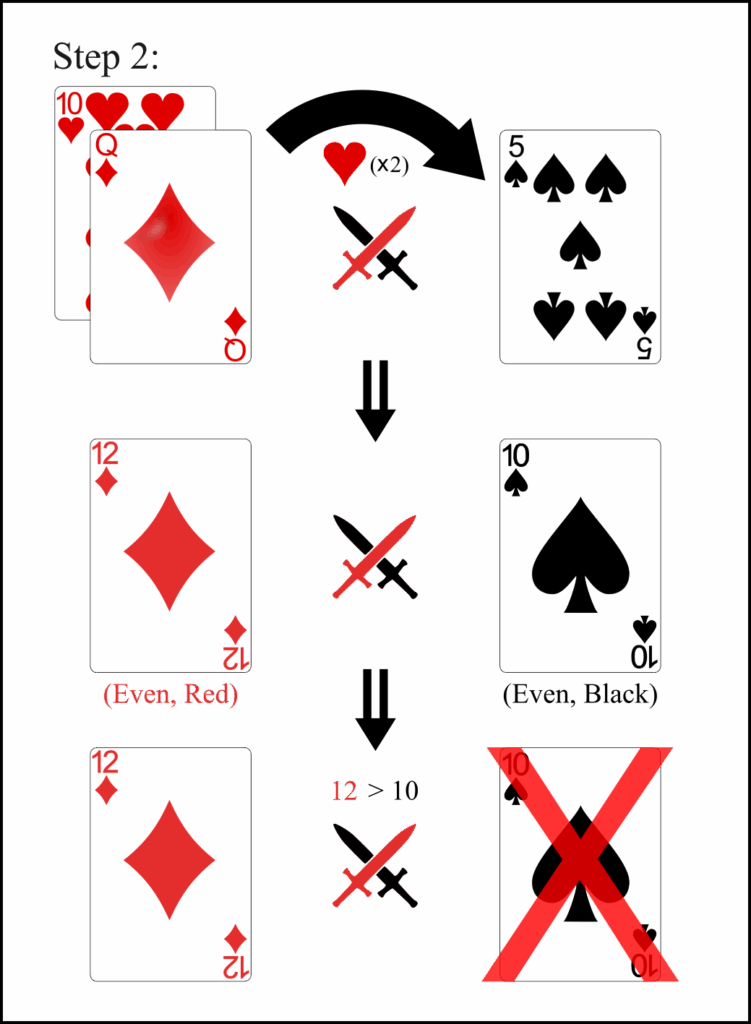
- If both cards have the same parity (both even or both odd): the higher number wins. If both cards have the same numerical value, then it is a stalemate and neither card is defeated.
- If the cards have opposing parity (even vs odd), then:
- If both cards are the same color: the even-parity card wins
- If both cards are different colors: the odd-parity card wins

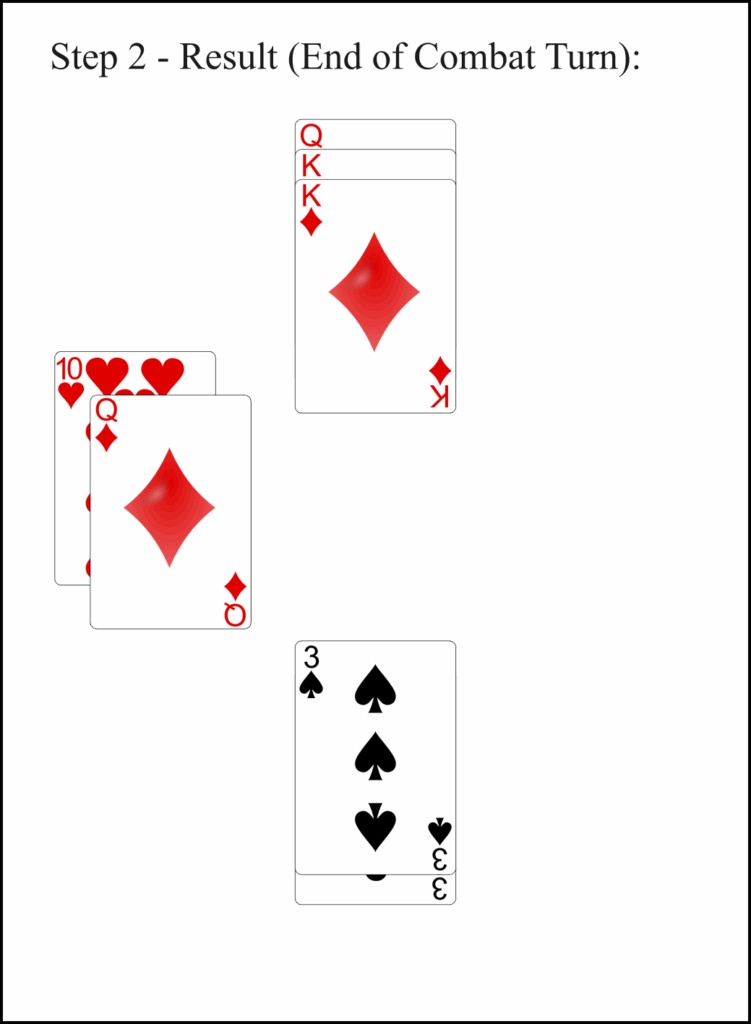
If a player’s Base is defeated, the top card of their Base is added to their hand. If the player already has seven cards in hand, the top card of the Base is discarded instead.
If a Striker is defeated, then both the Striker and Support are moved to the discard pile (the Support is placed in the discard pile first).
If a player attacks their opponent’s Striker and wins, the player may take their Support (if any) and place it at the bottom of their Base. The Support must conform to the Base’s pattern in order to be added. If the opposing Striker is defeated in any other way (i.e. the player did not play their red ace as their indicator card at the beginning of the combat turn or the player attacked with their Base), the player may not add their Support to their Base.
At the end of the combat turn, aces that are played as indicator cards are returned to their respective player (each player must always have access to a red and black ace). Any other card played as an indicator card is placed in the respective player’s discard pile.
Supports:
Supports augment how two cards battled in accordance with their suit:
- Clubs: the numerical value of the opponent’s Striker/Base is increased by 7.
- Hearts: the numerical value of the opponent’s Striker/Base is doubled.
- Diamonds: if the two cards have opposing parity: the even-odd combat interaction is reversed. i.e.
- If both cards are the same color: the odd-parity card wins
- If both cards are different colors: the even-parity card wins
- Spades*: If both cards have the same parity: the lower number wins.
Example:
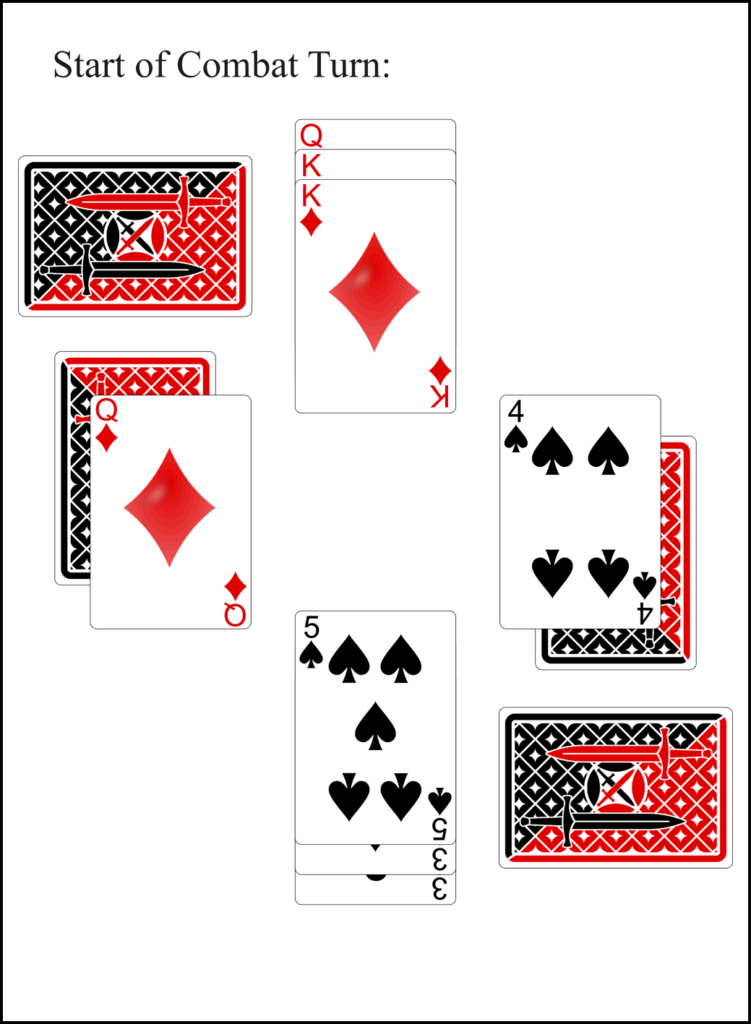
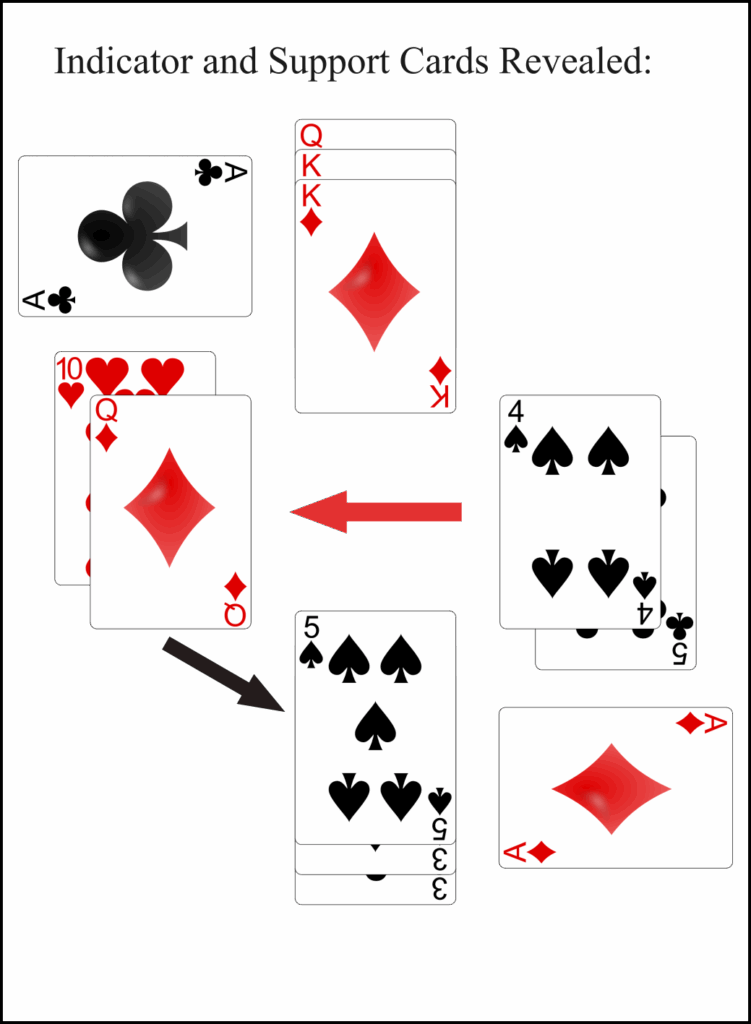
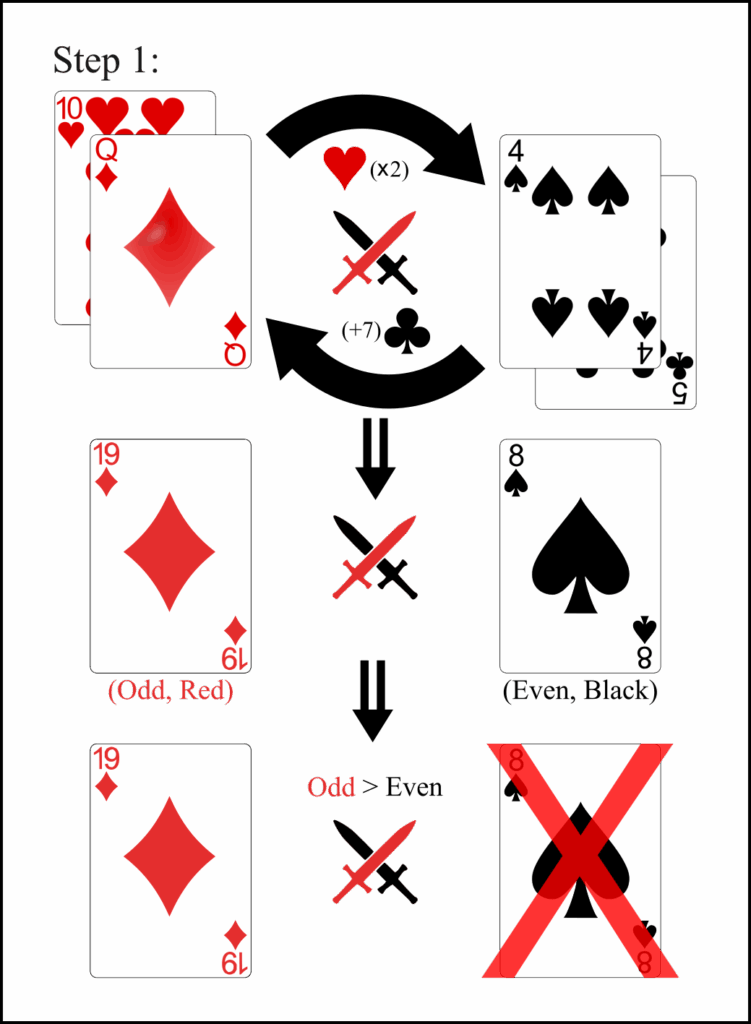
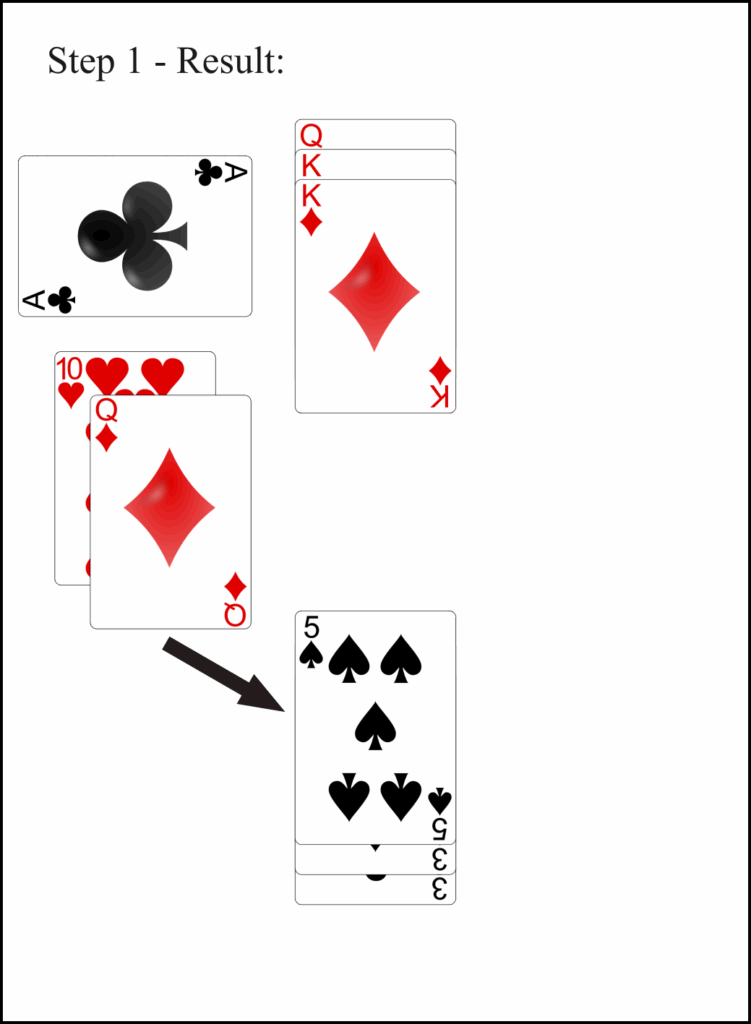
The Following is an example of a full round of combat,
Azbar Ruleset:
*In the Azbar ruleset, spades apply a different Support effect: spades nullify the effect of the opponent’s Support, but only if the opponent’s Support has the same suit as the player’s Striker/Base.
The numerical value of a Gambit is the product of all the numerical values of the composing cards multiplied together (e.g. a Gambit of three 4’s = 4x4x4 = 64). Gambits are not immune to the even-odd combat interaction nor the effects of an opponent’s Support. If a Gambit has a spades Support, the suits of every card above the Gambit’s Support is nullified by the spades. If the Gambit attacked and defeated the opponent’s Striker, the owner of the Gambit may add every card beneath the Striker to their Base (so long as they all conform to the Base’s pattern). At the end of the combat turn, if the Gambit is still in play, every card in the middle of the Gambit is discarded leaving only the Striker and Support (if it wasn’t added to the player’s Base) regardless of whether or not the Gambit attacked/was attacked.
Subscribe
For updates and news on upcoming projects
Thank you!
You have successfully joined our subscriber list.